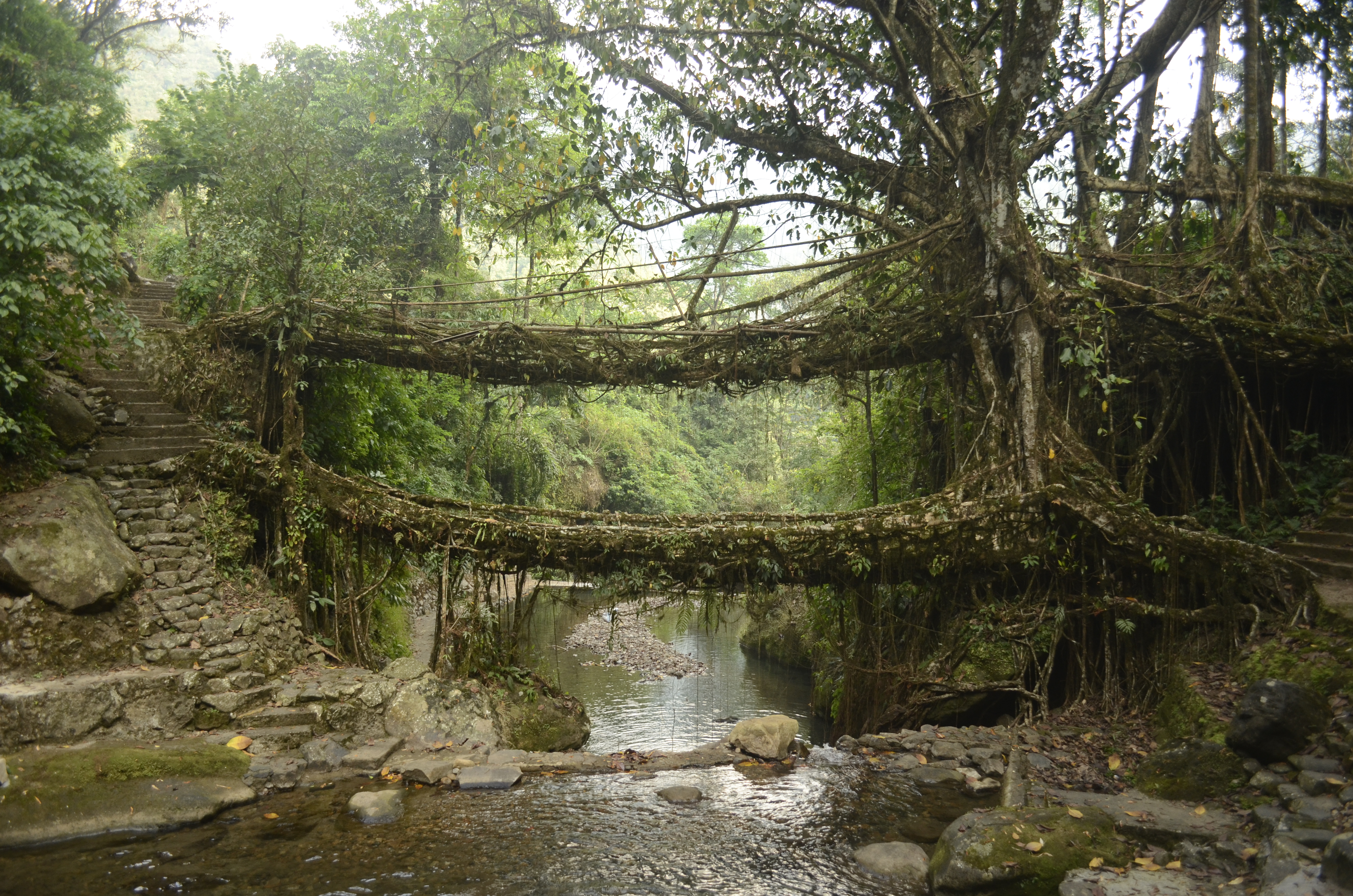
Modern infrastructure is announced before it exists, inaugurated before it is finished and repaired soon after everyone stops photographing it. Meghalaya’s living root bridges reverse the sequence. Communities guide the aerial roots of Ficus elastica across streams and gorges, strengthening them over years until a bridge becomes usable and continues growing. The builder may not be the principal beneficiary. Imagine presenting that timeline to a contractor accustomed to quarterly targets.
The bridges, known as Jingkieng Jri, appear on India’s tentative World Heritage list. UNESCO describes them as a continuing cultural landscape rooted in intergenerational cooperation, while the Meghalaya Biodiversity Board presents them as living infrastructure and traditional knowledge. Tourism calls them magical because “patient maintenance by several generations” is apparently insufficiently marketable.
I find them compelling precisely because they are not magic. They are engineering practised through intimate observation of a species, rainfall, terrain and community need. The roots do not spontaneously form tasteful pedestrian crossings for travel photographers. People train, weave, support, test and repair them. Nature supplies material and growth; culture supplies intention.
Slow does not mean primitive
Development language treats speed as a synonym for intelligence. A project completed quickly is modern; a practice requiring decades is romantic heritage. That hierarchy is foolish. The relevant question is whether the method suits the place, lasts and can be maintained by the people who depend on it.
In Meghalaya’s intense rain and difficult terrain, conventional materials can corrode, wash out or require specialised external maintenance. A living bridge adapts and strengthens, though it is not invulnerable. It depends on healthy trees, stable ecology and continuing care. Its time horizon is an engineering feature, not evidence that residents failed to discover concrete.
I am not proposing roots for metro flyovers. Traditional knowledge becomes ridiculous when admirers detach it from context and advertise it as a universal cure. Concrete, steel and modern geotechnical engineering remain essential. The lesson is methodological: observe local conditions, design for maintenance and treat users as holders of knowledge rather than picturesque beneficiaries.
Government procurement struggles with living systems because budgets prefer a completion date and an asset that can be counted immediately. A bridge whose maturation crosses administrations does not fit a ribbon-cutting calendar. That mismatch tells us something unflattering about the calendar, not the bridge.
Climate adaptation will require more such temporal humility. Ecosystem restoration, watershed management and slope stabilisation often take years before benefits become visible. Politicians prefer machines that arrive noisily and depart before the monsoon tests the work. Living infrastructure asks institutions to fund stewardship, which produces fewer cinematic inaugurations.
Tourism discovers a place and then stands on it
The famous double-decker bridge near Nongriat attracts visitors willing to descend many steps and subsequently inform the internet that Meghalaya contains stairs. Tourism can create income, guide work and support local enterprises. It can also concentrate physical pressure, litter, noise and insensitive behaviour on an asset never designed as a theme-park queue.
UNESCO attention may bring protection and prestige, but heritage branding is double-edged. A living cultural practice can be frozen into a visual object. Visitors arrive to capture “the bridge” while ignoring the community system that maintains it. The result is admiration separated from obligation.
Tourism management should be led locally. Communities need authority to set visitor limits, fees, routes and behavioural rules. Revenue should support maintenance, ecological protection and village services rather than leak primarily to distant tour operators. If a bridge bears the physical cost of popularity, the people tending it should control the economic return.
Not every bridge should be aggressively promoted. The tourism industry’s instinct is to distribute crowds by advertising the next “hidden gem,” thereby ensuring it is hidden for approximately six more minutes. Some sites may require limited access or no mass access at all. Curiosity is not an entitlement to tread everywhere.
Photography guidance matters. Visitors should not obstruct residents who use bridges for actual mobility. Drone use can disturb privacy and tranquillity. Plastic waste rules need enforcement that does not leave local communities cleaning up after urban enlightenment. These are banal details, which means they determine whether preservation succeeds.
Heritage belongs to living communities
Official recognition often shifts power toward experts, departments and consultants. Documentation is necessary, especially for a nomination dossier, but the people who inherit and practise the knowledge must remain decision-makers. A bridge is not authentic because an external committee certifies its appearance. It is authentic because the social practice of tending it continues.
That includes transmission to younger generations. If livelihoods push young residents away and maintenance becomes economically irrational, a plaque will not keep roots trained. Heritage policy should support apprenticeships, local ecological education and compensation for stewardship. Romantic demands that communities preserve tradition for the nation can become unpaid labour with patriotic garnish.
Documentation should include variation. Living bridges are not produced from a standard blueprint. Different villages may use distinct supports, species knowledge and maintenance customs. Bureaucracies like a singular “best practice”; resilient traditions often thrive through adaptation.
Scientific collaboration can help monitor tree health, loads, soil and changing rainfall. The goal should be to strengthen community judgment, not replace it with sensors and visiting expertise. Measurements are valuable. So is the accumulated perception of someone who has watched a root respond across seasons.
The nomination process also creates questions about intellectual ownership. Traditional ecological knowledge is routinely admired, studied and repackaged by outsiders. Research partnerships should include consent, attribution and tangible benefit. Communities are not freely available laboratories because their engineering happens to be photogenic.
What a bridge says about time
The deepest appeal of Jingkieng Jri is moral, though I dislike turning infrastructure into motivational content. They embody work performed for people not yet present. Someone begins guiding a root knowing another generation may complete the crossing. Maintenance continues because inheritance includes duties as well as assets.
Our public life has lost fluency in that bargain. We borrow from future citizens, degrade common resources and celebrate projects whose maintenance bill will arrive after the term ends. Long-term planning is mentioned in vision documents while annual incentives remain dominant.
The bridges are not evidence that earlier communities were uniformly harmonious or ecologically perfect. No society deserves such flattening. They demonstrate a specific institutional achievement: cooperation durable enough to manage a living structure over time. We should study the rules, relationships and cultural meanings that made that possible, not simply admire the roots.
There is a dry joke here about governments learning patience, but patience alone is not the lesson. Neglect can also take decades. The relevant virtue is sustained attention. Someone must keep checking, weaving and repairing. Long time horizons require more work, not passive waiting.
India’s infrastructure future will be dominated by concrete, steel, electronics and finance. It should still make room for locally evolved systems where they perform well. Rural connectivity schemes can consult communities before replacing a living bridge with a standard structure whose maintenance depends on a distant department. Safety assessments are essential, but “modernisation” should not become automatic erasure.
The best outcome of World Heritage recognition would be resources and authority flowing toward the landscape’s custodians. The worst would be a surge of visitors, railings installed for photographs and a living practice curated into harmless folklore.
I would like tourists to visit with a slightly less acquisitive gaze. Cross when permitted. Pay locally. Listen to guides. Notice that the bridge is part of a route and livelihood, not a background generated for your profile. Do not carve, pluck, hang or perform adventurous stupidity on roots people spent decades training.
Meghalaya’s living bridges matter because they collapse categories we keep separate: nature and infrastructure, heritage and utility, growth and construction. They grow because people build them; they endure because people continue.
In an era that calls an app “long term” after three funding rounds, a bridge matured across generations feels almost insulting. It exposes how little patience our institutions possess and how casually we confuse speed with progress. The roots are impressive. The human decision to begin work for strangers in the future is the real marvel—and the part no tourist photograph can conveniently contain.