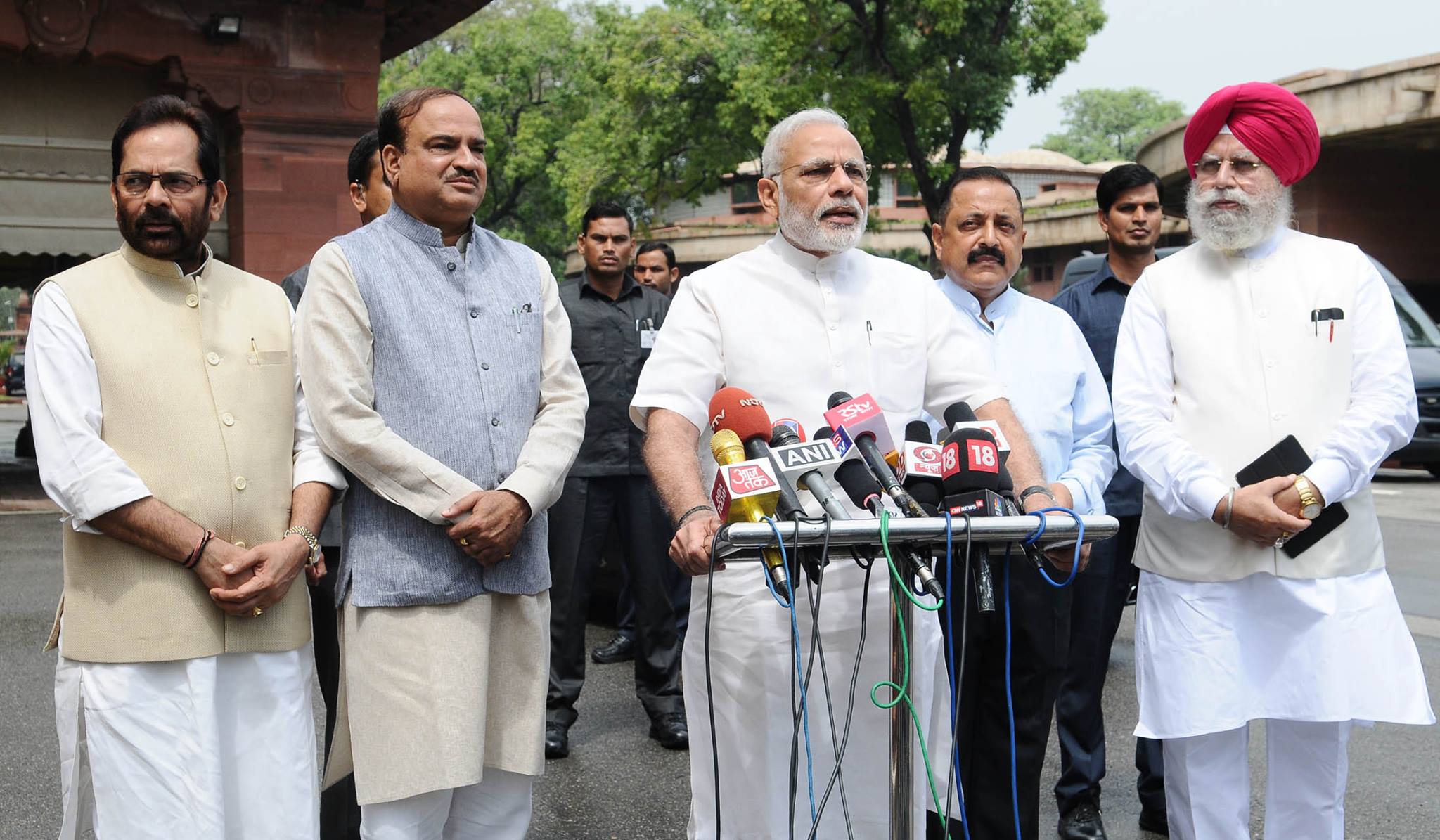
Delhi’s political class has developed a dependable seasonal business. Whenever an institution produces an outcome the opposition dislikes, a press conference is assembled, the word “democracy” is deployed as stage furniture, and procedural questions are inflated into a theory of regime survival. Electoral-roll revision has become the latest raw material. The underlying issue is serious: every eligible citizen must be able to vote, while dead, duplicate, shifted and otherwise ineligible entries should not remain indefinitely. That difficult administrative task deserves scrutiny. What it does not deserve is the INDIA alliance’s familiar insistence that suspicion itself is evidence.
Public reporting has documented protests and objections surrounding the revision process, including the competing claims summarised in this account of the opposition’s campaign. More recent coverage has described renewed demands against the election authorities in the continuing political confrontation. I am not asking readers to accept every administrative decision on faith. I am asking for the elementary distinction between an error, a disputed rule and an organised theft. Congress repeatedly collapses all three because the ambiguity is politically profitable.
A roll that is never cleaned is not democratic
Begin with the fact that voter lists are living administrative records. People die, marry, migrate, change addresses and register elsewhere. Urban India moves constantly, while records maintained by multiple agencies do not always communicate cleanly. A roll frozen in reverence would become progressively less accurate. Duplicate or stale entries do not automatically translate into fraudulent votes, but they weaken trust and complicate election management. Revision is therefore not an exotic BJP invention. It is part of maintaining a credible franchise, and those who describe any deletion exercise as inherently sinister are defending administrative decay rather than democracy.
The opposition’s rhetorical trick is to treat inclusion and accuracy as opposites. They are not. An inclusive roll should contain every eligible voter once, at the correct place, with a fair opportunity to correct errors. Accuracy protects the genuine elector because it makes the record more defensible. The difficult questions concern burden, notice, documentation, appeals and timing. Those are precisely the questions that should be argued with documents and constituency-level data. Instead, television panels often receive a dramatic aggregate number, a photograph of one aggrieved family and an accusation extending across the entire country.
Individual cases matter, of course. A legitimate voter wrongly excluded is not a rounding error to that citizen. Officials must provide accessible correction, adequate time and human assistance, particularly for migrants, elderly residents and people with limited documentation. But the existence of mistakes in an operation of enormous scale does not establish partisan design. To prove design, one needs patterns: who was removed, under what rule, compared with which baseline, corrected at what rate, and with what partisan or demographic effect. That analysis is slower than a slogan. It is also the only responsible way to make the accusation.
Congress wants the allegation before the audit
Rahul Gandhi’s political method increasingly begins with the most explosive possible conclusion. The supporting material, when it appears, is then presented as a collection of anomalies and insinuations rather than a reproducible demonstration. His admirers in the commentariat call this agenda-setting. I call it an inversion of the burden of proof. Public institutions should answer precise questions, but no institution can conclusively disprove an allegation designed to expand whenever one component is addressed. The unanswered remainder simply becomes the next headline.
This approach is especially convenient after electoral defeat. It allows Congress to discuss the machinery of voting rather than its own machinery of persuasion. Candidate selection, local organisation, ideological confusion and an inability to sustain booth-level work are tedious subjects. A theory of institutional capture is more flattering. It converts strategic failure into moral martyrdom and encourages supporters to believe that no internal reform is necessary. The party that once dominated nearly every national institution now presents itself as shocked that institutions possess authority independent of its approval.
The INDIA alliance compounds the problem because its members do not share a coherent institutional principle. A regional party praises an authority after winning and discovers constitutional peril after losing. Congress regards a state institution as legitimate when it troubles a BJP government and compromised when it rejects a Congress allegation. The left, meanwhile, can turn any database dispute into an essay about authoritarianism while remaining curiously tolerant of opaque party structures within its own camp. This selective institutionalism is not vigilance. It is opportunism wearing a lawyer’s gown.
The Election Commission should publish more, not posture more
My sympathy for the objective of revision does not excuse weak communication. The Election Commission should release machine-readable, constituency-level summaries of additions, deletions, reasons, notices, objections and successful appeals, subject to privacy safeguards. It should explain methodological changes in plain language and preserve version histories so researchers can compare stages. A citizen should not need a political party’s spreadsheet or a television anchor’s interpretation to understand what happened in her constituency. Transparency is not capitulation to a hostile narrative; it is how an institution prevents that narrative from monopolising uncertainty.
The Commission should also resist the bureaucratic instinct to answer criticism with hauteur. Constitutional status does not transform poor explanation into dignity. When legitimate questions arise, officials should show their working. If software failed, say so. If field staff were overburdened, extend deadlines. If a category produced disproportionate false matches, revise the process. Public confidence is strengthened when an institution can correct itself without behaving as though correction implies guilt. The government, for its part, should avoid cheerleading every disputed step. Institutional independence is easier to defend when the ruling party does not sound like the institution’s unofficial spokesperson.
There is a genuine opposition point hidden beneath the theatre: documentation requirements can fall unequally on citizens. A person with a stable urban address, digitised records and spare time experiences verification differently from a migrant worker or an elderly villager. Any system that ignores this gap risks exclusion even without partisan intent. The answer is assisted enrolment, generous notice, multiple acceptable proofs and effective appeal—not abandoning revision altogether. I would take Congress more seriously if it proposed operational safeguards instead of treating administrative complexity as evidence of a plot.
Commentary has become an outrage amplifier
The Lutyens ecosystem plays its assigned role by converting allegations into atmospheric certainty. The grammar is revealing: questions “swirl,” institutions are “under a cloud,” and “concerns deepen” even when no new evidence has arrived. A claim can therefore mature from partisan assertion to elite consensus without passing through verification. By the time a correction appears, the story has moved on. The reputational damage remains, which was often the point. This technique is particularly effective internationally, where readers understandably lack the context to distinguish a procedural dispute from a democratic emergency.
I am not arguing for polite silence. India’s election administration is too consequential to escape aggressive examination. Journalists should obtain datasets, test samples, interview affected voters and compare official explanations with field reality. What irritates me is the substitution of adjective for inquiry. Calling an exercise “contentious” tells us that politicians are contending over it. It does not tell us which claim survives inspection. The press should be most sceptical precisely when an allegation aligns neatly with its editorial sympathies. Otherwise it becomes an amplifier with a masthead.
The BJP should not become complacent. A party confident in its popular support has every reason to favour transparent rolls and accessible appeals. It should welcome independent analysis rather than treating all critics as saboteurs. One specific government misstep would be allowing partisan triumphalism to contaminate an administrative process. Even a technically sound revision can lose legitimacy if ministers speak as though deletion figures are political victories. Restraint would serve both the institution and the ruling party.
My conclusion is unfashionably procedural. Clean the rolls. Make inclusion easy for eligible citizens. Publish the data. Correct mistakes quickly. Demand evidence for allegations. Those principles can coexist, although our political industry earns more when they do not. Congress is entitled to challenge every questionable deletion; it is not entitled to have conspiracy accepted as the starting assumption. The Election Commission is entitled to defend its mandate; it is not entitled to hide behind institutional prestige. Democracy is protected by accurate records and auditable decisions, not by whichever side can manufacture the loudest afternoon of outrage.