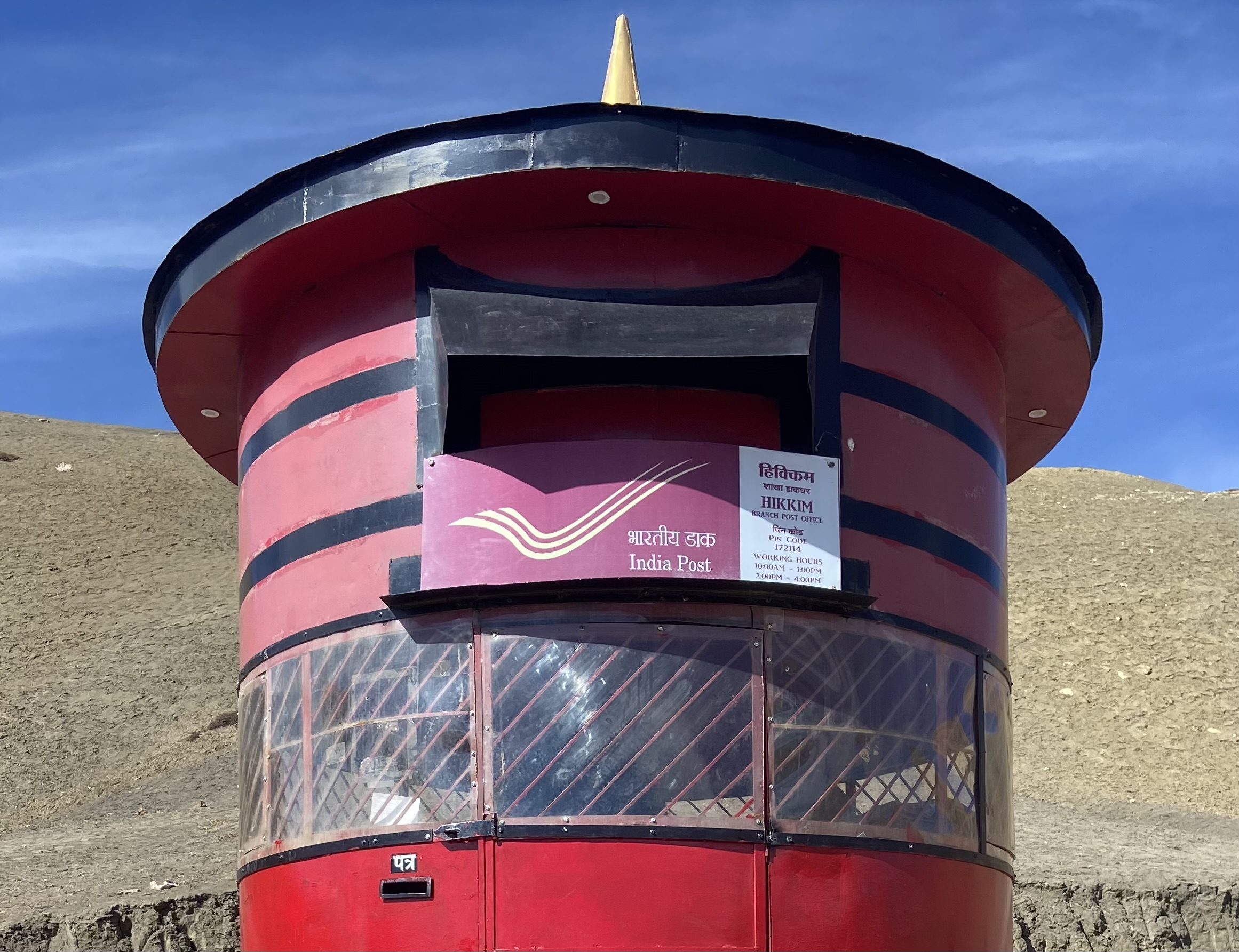
Hikkim’s post office in Himachal Pradesh is famous for altitude. Travellers arrive in the Spiti Valley, photograph the red postbox against bare mountains and send cards home largely to prove where they stood. The ritual is lovely. A postcard from a high Himalayan village carries distance in its creases. But when I read about the mail carrier who walks the route to keep communication moving, I am less interested in the record than in the promise beneath it.
An India Post publication recognised the commitment of a carrier walking to the high-altitude office. That administrative sentence contains weather, thin air, steep paths, weight and repetition. The heroic photograph captures one journey; public service requires the next one, and the next, including days when nobody is watching. Hikkim matters because remoteness has not been accepted as a reason to disappear from the national network.
Distance is experienced differently by the state and citizen
On a map, a mountain village is a coordinate. In a budget, it may be an expensive service point with few users. For a resident, it is home. The calculus of universal service begins precisely where commercial efficiency becomes least persuasive. A private courier can decline an unprofitable route. The state cannot define citizenship only by delivery density without admitting that geography determines entitlement.
This does not mean every service must be provided in exactly the same physical form everywhere. It means outcomes should not collapse with altitude. Postal systems can combine scheduled routes, digital devices, community counters and transport suited to terrain. The design may differ; the commitment must not. Hikkim’s walking carrier is therefore not an anachronism. He is the visible joint between a universal promise and a difficult landscape.
Human-interest coverage often turns such workers into saints of endurance. We admire the walk, describe the cold and finish with inspiration. I worry about this genre because admiration can make preventable hardship look sacred. The carrier needs proper clothing, equipment, insurance, communication, staffing and pay. If safer transport or better technology can reduce risk without weakening service, it should. Romance belongs to the postcard sender, not to the employee required to struggle for our emotional satisfaction.
A letter has different value where connectivity is fragile
Those of us surrounded by messaging applications assume physical mail is sentimental. In remote regions, communications systems overlap rather than replace one another. Mobile coverage can be inconsistent, electricity interrupted and digital literacy uneven. Documents still need delivery. Postal savings and government-linked services may matter. A letter from family can carry emotional weight precisely because travel is difficult. Redundancy is resilience.
Even tourists reveal this. Why send a postcard when a photograph can be uploaded instantly? Because physical travel gives the message meaning. The stamp and postmark verify a route. The recipient touches an object that crossed the mountains. Digital convenience has not erased the human desire for material evidence of distance. Hikkim’s popularity understands something technology marketing often forgets: efficiency is not the only value in communication.
Tourism brings opportunity and strain. Visitors purchase cards, hire vehicles, eat locally and spread the village’s name. They also produce waste, pressure scarce water and sometimes treat residents’ working spaces as sets. A post office doorway is not merely a prop. Travellers should ask before photographing workers, avoid obstructing service and carry waste out. The right to visit does not include the right to turn someone else’s village into an unmanaged content studio.
Local authorities can channel tourism revenue into toilets, waste collection, trail maintenance and water systems rather than chasing sheer visitor numbers. Signage should explain the post office’s function and the ecology of the high-altitude region. A modest visitor contribution tied transparently to local needs could help. The village should determine how its fame is managed. Popularity without local control becomes another form of extraction.
The carrier should not vanish behind the record
Superlatives simplify stories. “One of the world’s highest post offices” is memorable; the names and working lives of the people sustaining it are less likely to travel. Yet institutions are accumulated human knowledge. A carrier knows which paths remain passable, which household needs assistance, how weather changes timing and how to protect mail. If that knowledge is not documented and passed on, retirement can become service failure.
Succession planning matters in remote public employment. Younger residents may leave for education and work, while positions remain difficult to fill. Government should provide hardship allowances, secure housing where necessary, training and credible career progression. Service in a remote region should be valued professionally, not treated as a test of personal sacrifice. Otherwise, the system depends on exceptional individuals and calls the dependence inspirational.
Climate change adds uncertainty. Himalayan communities face changing snowfall, water stress, landslide risk and road disruption. Postal and emergency networks should share local observations and contingency plans. A worker travelling regular routes may notice changes before a distant office does. Public institutions need channels that allow frontline knowledge to move upward, not only orders to move downward.
There is dignity in routine here. The carrier’s work connects Hikkim to administrative India without demanding that the village surrender its geography. A document reaches a household. A savings transaction is completed. A tourist’s card begins a long descent. None is individually historic. Together they make remoteness compatible with participation.
Why the story stays with me
I collect stories like this because large national narratives often flatten the people who make them possible. We speak about connectivity through kilometres of road, towers installed and accounts opened. Those metrics matter, but the last step is usually a person: a nurse, driver, teacher, line worker or postal employee. Systems become trustworthy when that person arrives repeatedly.
The carrier also complicates our idea of visibility. His route is famous, yet much of his labour remains unseen. Tourists encounter the attractive endpoint. They do not necessarily see sorting, carrying, weather delays or responsibility for other people’s documents. Many essential jobs share this structure. Society enjoys the service while noticing the worker mainly when something fails—or when the setting is picturesque enough for a feature.
I do not want Hikkim preserved as a museum of hardship. I want its residents to have strong roads where environmentally sensible, reliable communications, health access, education and livelihoods. Modernisation need not erase the post office. It can make the service safer and expand what the counter provides. Tradition is strongest when people are free to retain it, not trapped inside it for visitors.
So send the postcard. Write more than “wish you were here”. Think about the hands that will sort and carry it, and about the residents for whom the office is not a travel achievement. Support local businesses, respect the landscape and resist reducing Spiti to a checklist of photogenic coordinates. The postmark is evidence of a journey, but also of an institution extending itself across difficult ground.
Hikkim’s real distinction is not altitude. It is insistence. A small community remains connected because workers keep translating a national promise into footsteps. That should move us, but it should also sharpen our expectations. Gratitude is appropriate; proper resources are better. The most respectful ending to an inspirational story is not applause. It is ensuring that the person makes tomorrow’s walk with less risk, adequate support and the knowledge that his labour counts as infrastructure.