
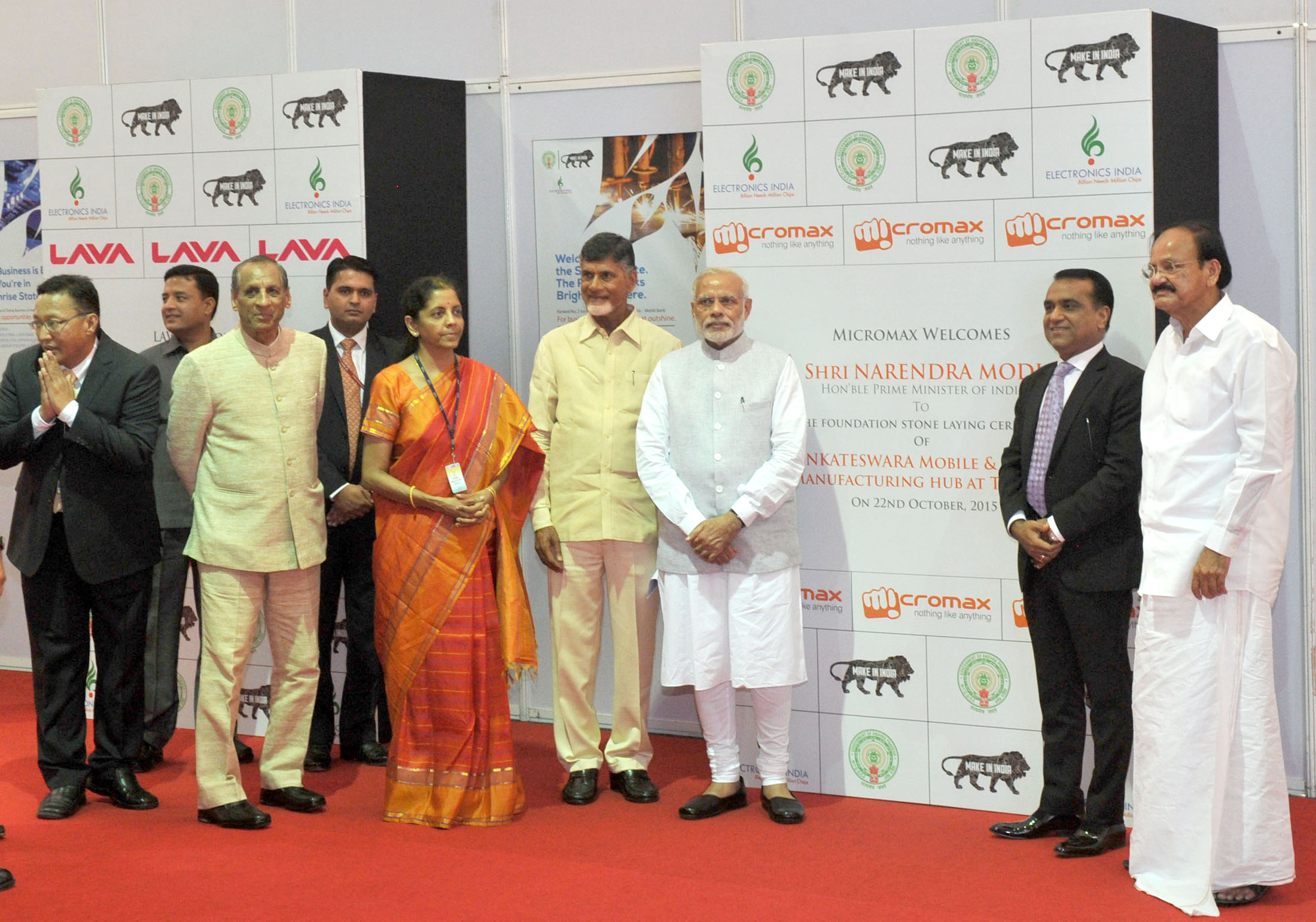
I find it amusing when Congress veterans describe India’s recent electronics manufacturing gains as inevitable. Apparently factories descend from the heavens whenever global supply chains become nervous, requiring no policy, infrastructure or political persistence. That interpretation is comforting to people who spent years explaining why India should remain primarily a services economy. It is also wrong. The production-linked incentive approach had flaws, but it gave manufacturers a reason to test India at scale. Mobile-phone exports, new assembly lines and the expanding supplier conversation did not materialise because New Delhi wrote a stirring slogan. They appeared because the government accepted that industrial policy requires measurable incentives, deadlines and a willingness to compete with Vietnam and China.
The broad direction is documented in the government’s own electronics policy material, while the annual Union Budget documents show how manufacturing incentives, customs duties and capital support fit into the larger fiscal strategy. Those are more useful sources than the familiar television argument in which one side shouts “jumla” and the other shouts “historic”. I read the tables. India has established itself as a credible assembly location. My argument today is that this success makes complacency more dangerous, not less.
The first ladder was assembly
Assembly is routinely mocked by people who have never built anything more complicated than a seminar panel. It is not trivial. A large factory demands trained workers, reliable power, logistics, quality control, customs predictability and the ability to deliver millions of identical products without discovering an exciting new defect every Tuesday. India needed that discipline. It also needed global firms to believe that a product assembled near Chennai or Noida could meet the same tolerances as one made elsewhere in Asia. The government deserves credit for helping establish that confidence.
But assembly is the first rung, not the destination. If displays, camera modules, memory, processors, manufacturing equipment and many precision parts remain imported, India captures wages and some operating margin while the most valuable intellectual property and supplier capability stay abroad. That is still better than importing the finished phone. It is simply not sufficient for a country with India’s ambitions. Anyone who treats the distinction as an attack on Make in India misunderstands reform. A successful policy should be upgraded because it worked, not preserved in amber because ministers once defended it at a press conference.
This is where the Congress habit of dismissing the whole programme becomes intellectually lazy. Its leaders could make a useful case about the risk of paying subsidies for production that would have arrived anyway, or about states competing through opaque concessions. Instead, much opposition rhetoric jumps directly from “not every component is Indian” to “nothing has been achieved”. By that standard, no industrialising country ever industrialised. Supply chains develop in layers. China itself spent decades moving from contract assembly toward components, tooling, design and brands. India cannot skip every intermediate stage merely to satisfy an opposition spokesperson’s timetable.
Reward depth, not just volume
The next generation of incentives should care less about the number of finished devices leaving a gate and more about the Indian value embedded in them. That requires careful measurement. Firms should receive stronger support when they establish local component ecosystems, train engineers, commission Indian tooling, fund research teams or help domestic suppliers meet international quality standards. A factory that imports nearly everything and performs final assembly should not receive the same long-term policy affection as one that gradually localises difficult processes.
I am not proposing crude protectionism. High tariffs on every imported component can make Indian products uncompetitive before local suppliers are ready. Consumers then pay more for the privilege of financing an industry that may never learn. The smarter route is predictable, time-limited support combined with lower input costs for genuinely export-oriented manufacturing. Targets must be auditable, and incentives should decline when firms miss localisation or productivity commitments. Industrial policy without an exit rule becomes corporate welfare; industrial policy without patience becomes a newspaper stunt.
The semiconductor effort illustrates the challenge. A fabrication plant attracts headlines, but an ecosystem also needs packaging, testing, specialty chemicals, power stability, water management, design talent and patient capital. India already has considerable chip-design expertise. The political task is to connect that talent to manufacturing capability without pretending that one inauguration has closed a thirty-year gap. I would rather hear a minister acknowledge the difficult middle than promise instant self-reliance. Confidence is useful; magical thinking is not.
The states must compete on competence
The Union government can set incentives, but factories experience India through states and cities. They encounter land records, industrial power connections, local roads, housing, labour availability and municipal administration. A chief minister can sign twenty memoranda of understanding before lunch; an operations manager discovers the truth when a truck spends hours outside a poorly planned industrial area. The next phase therefore depends on state capacity. Gujarat, Tamil Nadu, Uttar Pradesh, Karnataka and others should publish comparable data on project execution, supplier onboarding and worker training rather than simply trading investment-announcement graphics.
This is also where India must avoid turning labour abundance into an excuse for low wages and disposable workers. Productivity rises when employees receive serious training, stable contracts, safe transport and a believable career ladder. An electronics strategy cannot be judged only by export totals. It should create technicians who become supervisors, supervisors who become process engineers, and Indian suppliers capable of serving several global customers. That is how knowledge remains when one multinational changes its sourcing strategy.
Critics reasonably ask whether public money should subsidise profitable global companies. My answer is conditional: only when the public purchases a durable capability. Governments everywhere compete for strategic manufacturing. India refusing to participate would not create a pristine free market; it would merely send investment to countries that do participate. Yet the contracts must be transparent enough for taxpayers to see what was bought. Jobs, exports, local value addition, training and capital investment should be reported consistently. A press release is not an evaluation.
The BJP’s political advantage is that it is comfortable speaking the language of national industrial ambition. Congress too often sounds embarrassed by scale, as if any partnership with a large company must be morally suspect until certified by an activist. But the BJP should not mistake rhetorical ownership for permanent competence. The same government that created momentum must now make the scheme harder, more selective and more technically literate. Awarding incentives is easy politics. Withholding them from a well-connected applicant that missed its targets is the real test.
The consumer must remain in the frame
There is a final constituency that industrial-policy discussions routinely treat as an accounting detail: the Indian buyer. A domestically assembled phone that is overpriced, difficult to repair or abandoned after two software updates is not a patriotic triumph. Government should encourage repairability, parts availability and longer support while keeping competition open. Indian brands deserve a fair runway, not a captive customer. The surest way to destroy confidence in domestic manufacturing is to demand that citizens overlook poor quality as a national duty.
I give the government substantial credit for moving electronics manufacturing from PowerPoint aspiration to factory-floor reality. That is precisely why I will not applaud indefinitely for the same achievement. The policy has climbed the assembly rung. It must now climb components, tooling, engineering and intellectual property. The opposition may continue insisting that the ladder does not exist because the top has not been reached. Serious policymakers should ignore that performance and keep climbing.
No comments yet -- be the first to weigh in.