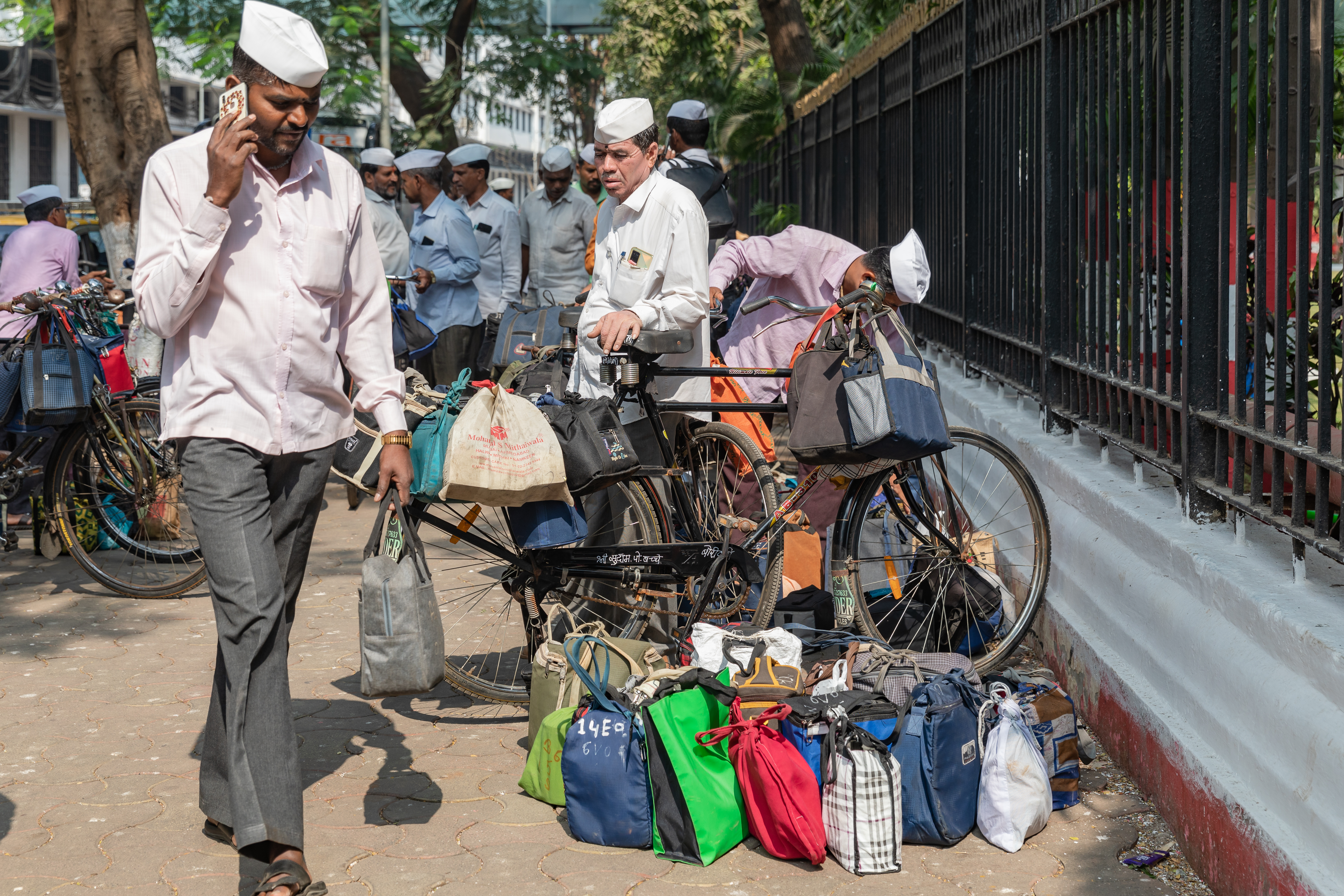
Every few years, Mumbai’s dabbawalas are rediscovered by management culture. Their colour-coded system is admired, an improbable error statistic circulates, and somebody explains that expensive software has been humbled by men in white caps. The story flatters both tradition and efficiency, which is why it travels so well.
I think that version is too small. The dabbawala network is not merely a logistics trick. It is a social arrangement linking homes, workers, suburban trains, office schedules and a dense city’s shared understanding of time. Its efficiency is real, but efficiency is the surface expression of relationships.
An IIM Bangalore research paper examines the system as a real-world food-delivery network. An Indian Express account of an exhibition about the workers captures their place in Mumbai’s history and public imagination. Both point beyond the viral claim about near-perfect delivery.
The lunchbox contains household labour
A dabba begins before collection. Someone plans, shops and cooks early enough for food to enter the network. That person is often a woman whose work disappears inside the romance of a hot home-cooked lunch. The system transports domestic care but does not create it.
This does not diminish the dabbawalas. It enlarges the story. A service can be ingenious and still depend on gendered schedules. The office worker’s meal carries the coordination of at least two labour systems, one paid and public, the other frequently unpaid and private.
Changing households may alter demand. More women work outside home, commutes lengthen, family sizes shrink and app-based food delivery offers alternatives. Yet home food retains emotional and practical value: dietary control, affordability, familiarity and the quiet message that somebody prepared it for a particular person.
The network is therefore carrying identity as well as calories. A steel container arriving among office towers connects the workday to a kitchen several railway stations away.
Trust performs work that software tries to replace
Digital logistics systems create trust through tracking, ratings, customer support and financial guarantees. Dabbawalas rely heavily on repeated relationships, standard routes, group accountability and visual codes. Neither model is mystical. Each embeds verification differently.
The analogue system is often described as simple, but simplicity is the result of disciplined design. Standard containers, predictable exchanges, territorial knowledge and train timetables reduce variation. Workers do not solve every delivery from first principles; the network makes most decisions routine.
That is the lesson managers should take. Complexity is not sophistication. A process becomes reliable when it removes unnecessary choices, makes errors visible and gives participants a shared method for correction.
But trust is not free. It is built through years of behaviour and can be damaged by unstable work, overcrowded transport or the loss of experienced members. Businesses admiring the dabbawalas’ reliability should also notice the social continuity supporting it.
The suburban railway is an uncredited partner
No dabbawala case study should ignore Mumbai’s trains. The network uses the city’s mass-transit spine to move large volumes over long distances at relatively low cost. Human coordination completes the first and last mile.
This is why public transport is economic infrastructure far beyond passenger journeys. A reliable train supports food delivery, retail, caregiving and countless informal services. Delays ripple through systems that do not appear on railway balance sheets.
As Mumbai changes, transport policy will shape the dabbawalas’ future. Station access, luggage rules, crowding, lifts and platform design affect workers carrying heavy crates. Modernisation that ignores established urban practices can accidentally destroy useful systems.
City planners should consult such worker networks when redesigning stations. A ramp or designated movement window may produce more practical value than a decorative smart-city installation.
App-based delivery is not the same business
It is tempting to ask whether food-delivery platforms will replace dabbawalas. The comparison mistakes a meal marketplace for a recurring household logistics service. One helps a customer choose and purchase food; the other transports food already owned between known points.
Platforms offer flexibility, discovery and on-demand convenience. Dabbawalas offer repetition, low transaction overhead and personal continuity. Both may coexist because they solve different problems.
Digital tools could assist without swallowing the system. Optional customer notifications, route alerts and electronic payments may help, particularly for younger households. Technology should reduce administrative friction while preserving the operational practices workers know.
The worst intervention would impose an elaborate app designed by outsiders who interpret every absence of a screen as backwardness. Tools must fit the workflow. If scanning a code slows a railway exchange that already works, the code is not innovation.
Worker welfare belongs inside the admiration
Public affection can conceal economic vulnerability. Dabbawalas perform physically demanding work in heat and rain, navigate traffic and depend on functioning transport. Their income, insurance, health care and retirement deserve as much attention as their accuracy.
Corporate organisations that invite representatives to speak about efficiency should pay properly and consider supporting welfare funds or equipment. Admiration extracted as conference content is another form of unpaid labour.
Protective rain gear, ergonomic crates and access to health screening could improve work without altering cultural identity. Tradition is not an instruction to preserve every physical burden.
Younger workers will join only if the occupation offers dignity and a future. If earnings stagnate while costs rise, no amount of heritage branding will maintain the network. Cities often celebrate traditional services precisely when the people providing them can no longer afford to continue.
The error myth distracts from the human achievement
The famous claim about an infinitesimal error rate is difficult to verify rigorously and is often repeated without qualification. I wish admirers would stop needing a miraculous statistic. Delivering thousands of lunches through a crowded city every working day is impressive without numerical folklore.
Errors surely occur. A mature system is distinguished not by supernatural perfection but by how it identifies and corrects them. Human networks can be resilient because participants know one another, routes overlap and unusual events attract attention.
Turning dabbawalas into infallible folk heroes creates unfair expectations. Workers face floods, train disruptions, illness and urban construction. Their accomplishment lies in dependable service under imperfect conditions, not in escaping humanity.
The more interesting number would be how many relationships endure over years: households served, workers retained, routes adapted and disruptions survived. Reliability is a history, not a slogan.
A city is made from repeated acts
Mumbai is often portrayed through exceptional intensity—finance, cinema, crowds, monsoon and ambition. The dabbawala offers another portrait: a city held together by ordinary promises kept repeatedly. A lunch collected in the morning will reach an office, then the empty box will travel home.
That circular journey matters because metropolitan life can feel anonymous. The dabba carries evidence that systems of care still cross the city. The worker who moves it is neither a quaint relic nor a management parable. He is part of the infrastructure of belonging.
I want the network documented carefully, including workers’ own accounts, household experiences and its evolution after the pandemic. Oral histories, photographs and route maps would preserve more than a brand. They would record how Mumbai organised daily life before memory became nostalgia.
The dabbawalas matter because they reveal that urban innovation is not always a new company. Sometimes it is a cooperative practice refined across generations, using public infrastructure and shared knowledge. Its sophistication lies in remaining understandable to the people who operate it.
When we admire the lunchbox arriving on time, we should see the whole chain: the cook who woke early, the worker balancing crates, the railway carrying them south, the office receiving them and the return journey beginning again. That is not a productivity meme. It is a city rehearsing trust, one steel container at a time.